
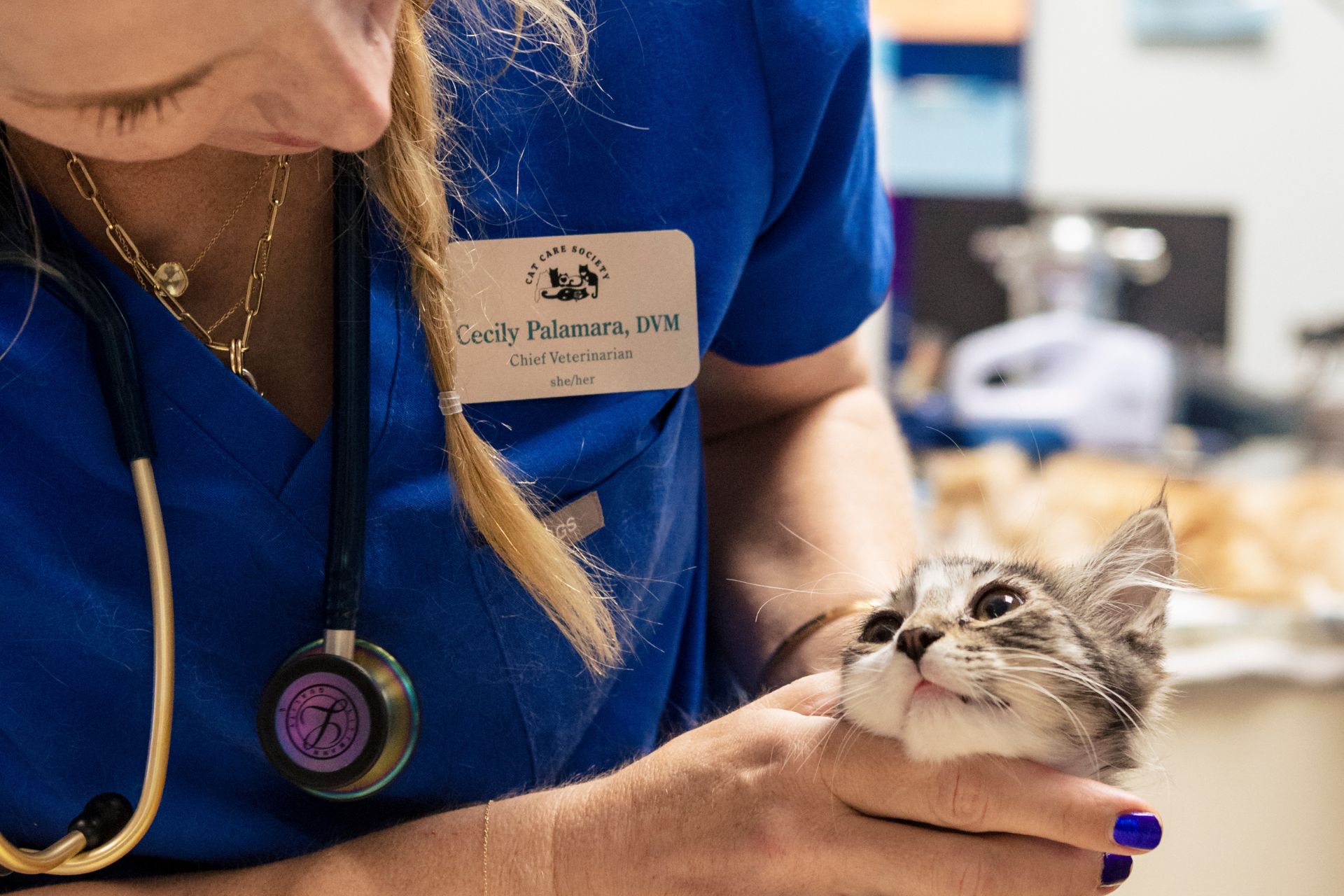
Just like humans, cats can suffer from a variety of allergies, including food allergies, environmental allergies, and flea hypersensitivities (an intense reaction to the proteins in flea saliva). While allergies are relatively common in cats, managing symptoms and identifying the underlying cause can be a long and often complex process, especially in a shelter environment, where many cats arrive without a known medical history.
At Cat Care Society (CCS), our veterinary team works to provide relief, improve quality of life, and help cats with allergies find loving homes. In a Q&A, Dr. Cecily Palamara, Cat Care Society’s Chief Veterinarian, answered a series of questions about cats with allergies, including the approach CCS uses to best support the cats and educate potential adopters to set them up for success.
What are the most common symptoms you see that indicate a cat may have an allergy?
Dr. Cecily Palamara: The most common symptoms we see in cats are overgrooming of the fur (which often causes hair loss), self-trauma/biting at the skin/fur, wounds, itchiness/frequent scratching, and scabbing/dermatitis associated with overgrooming and self-trauma.
Note: If these symptoms sound familiar and you suspect that your cat has an allergy, talk to your vet or visit our Veterinary and Medical Services resource page to find a vet for support. Also, check out other CCS blog posts related to cat health and medical care to stay informed about your cat’s wellness.
What are the steps taken at the shelter/veterinary care levels to address suspected allergies?
Dr. Cecily Palamara: The shelter approach to feline allergies is directed at alleviating symptoms rather than definitively diagnosing the underlying cause. When one of our vets suspects allergies in a patient (either food allergies, environmental allergies, and/or flea allergies), we focus on quick relief.
Any cat noted to have a history of severe skin issues or noted to have skin issues on intake to CCS (scratching, biting, scabbing, hair loss, etc.), receives a DVM exam (a comprehensive exam performed by a Doctor of Veterinary Medicine) to determine next treatment and diagnostic steps. We first rule out parasitic causes via skin scrapings and skin cytologies to rule out demodex (a mite) or other parasites, and all cats (regardless of skin condition) are treated with a topical antiparasitic upon arrival to CCS. Sometimes additional diagnostics, such as bloodwork and/or skin biopsies, are pursued depending on the appearance and severity of the skin lesions. If a CCS veterinarian suspects underlying allergies as a cause of the skin issues, the cat is usually started on the following:
- a special prescription diet to address potential food allergies
- an antibiotic injection to address secondary bacterial pyoderma (a skin infection) — sometimes we put them on stronger antibiotics depending on the severity of the infection
- Atopica, an immunomodulating oral medication that calms the cat’s itching sensation and is very successful at managing allergies long term in cats
Sometimes we will also concurrently start a shorter course of corticosteroids to get itchiness and inflammation under control more quickly, as the Atopica takes longer to take effect.
We do not perform specific allergen testing or treat with immunotherapy (this is sometimes recommended by dermatologists for diagnosis and treatment) as this is outside of our scope and would not often change the course of our in-shelter treatment.
How long does it typically take to get the allergy and its symptoms under control?
Dr. Cecily Palamara: Typically, it takes between 1-3 months for us to start seeing a positive response to treatment. Our suspected allergy cats are one of our longest stay cohorts of patients because we want to make sure that they are comfortable, well-managed on medication and diet, and have good quality of life prior to making them available for adoption. This takes time, frequent medication and diet adjustments, and frequent rechecks to assess response to treatment. Whenever available, we try to send these cats to a foster home while we await a response to treatment. We have had excellent success with our allergy cats, with only 1-2 cats in the last 4 years having a poor or inadequate response to treatment. One of these cats was referred to a dermatologist while in care for additional treatment suggestions and ended up having a successful adoption despite the individual challenges of her condition.
What is the most challenging part of working with cats who may have an allergy?
Dr. Cecily Palamara: The most difficult aspect of working with allergy cats is that they can be challenging to adopt out and typically have longer lengths of stay in shelter, even when they demonstrate a great response to treatment. We feel for these cats when they stay with us long term, often with no visible symptoms of allergies due to adequate medical management; their history and need for additional care can be a deterrent for prospective adopters. Our main goal and what makes us fulfilled as shelter workers is to find adoptive homes for these cats, so seeing them have longer stays in-shelter can be difficult.
The majority of our allergy cats show excellent response to care but will also need a dedicated guardian to provide lifelong care with diet, medication, frequent vet visits, and vet-supervised treatment/medication adjustments. This is why we try to achieve adequate management of symptoms prior to making these cats available, so that we can show potential adopters that management is possible with appropriate care. Most of our allergy cats require a DVM consult prior to adoption to discuss the complexity of care, the CCS approach to treatment, what long term care might look like with their veterinarian, and potential associated costs. We also provide one month of free medication and prescription diet to adopters of allergic cats.
Very rarely do we see cats that show a poor response to our in-shelter treatment approach. Those cats can be intensive to manage as they need more frequent medication additions and adjustments to manage quality of life.
For people considering adopting a cat with allergies, what should they know about allergy management and flare-ups?
Dr. Cecily Palamara: Our adopters should know that allergies (regardless of underlying cause) are often a life-long condition and will require more frequent vet visits and medication adjustments. CCS staff and veterinarians do our best to set adopters up for success with medication, special diet, and often a medical consultation to discuss what long term care will look like. These cats are incredibly rewarding to treat and make amazing companions when managed appropriately. Several of our adopters of allergic cats have disclosed that they have allergies or other medical conditions themselves and are empathetic to our allergy cats’ needs.
Closing Thoughts
With the right care plan and a dedicated caregiver, cats with allergies can live happy, healthy lives and be the purrfect companions. At CCS, we are committed to providing these cats with the time and medical care they need before adoption while equipping adopters with knowledge and resources to help their new family members thrive at home.
About the Author: Beth Dokolasa is a volunteer for Cat Care Society and serves on the Board of Directors. She is an instructional developer for Natural Grocers and lives in Indian Hills, Colo., with her husband, daughter, and two cats, Techno and Digit.